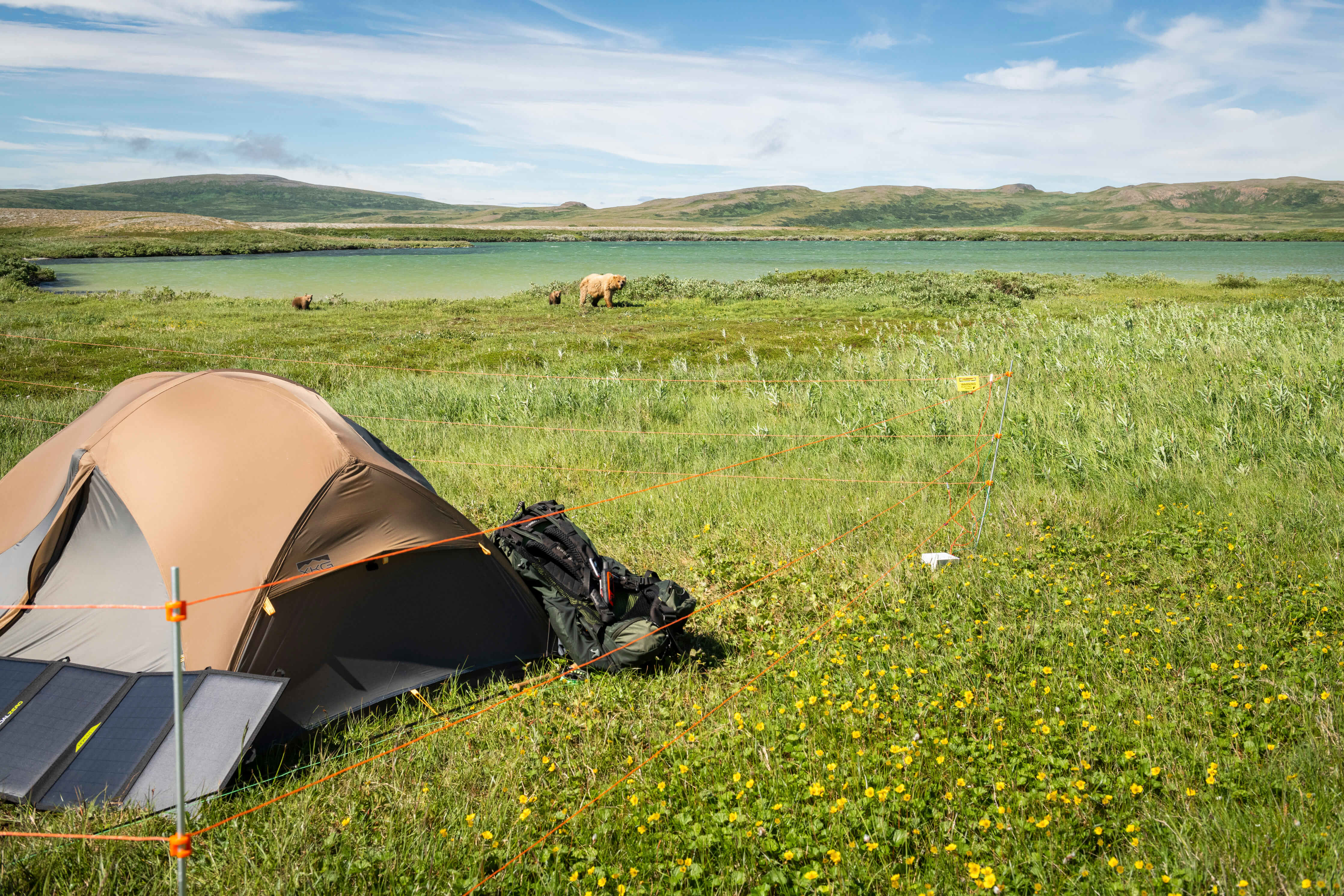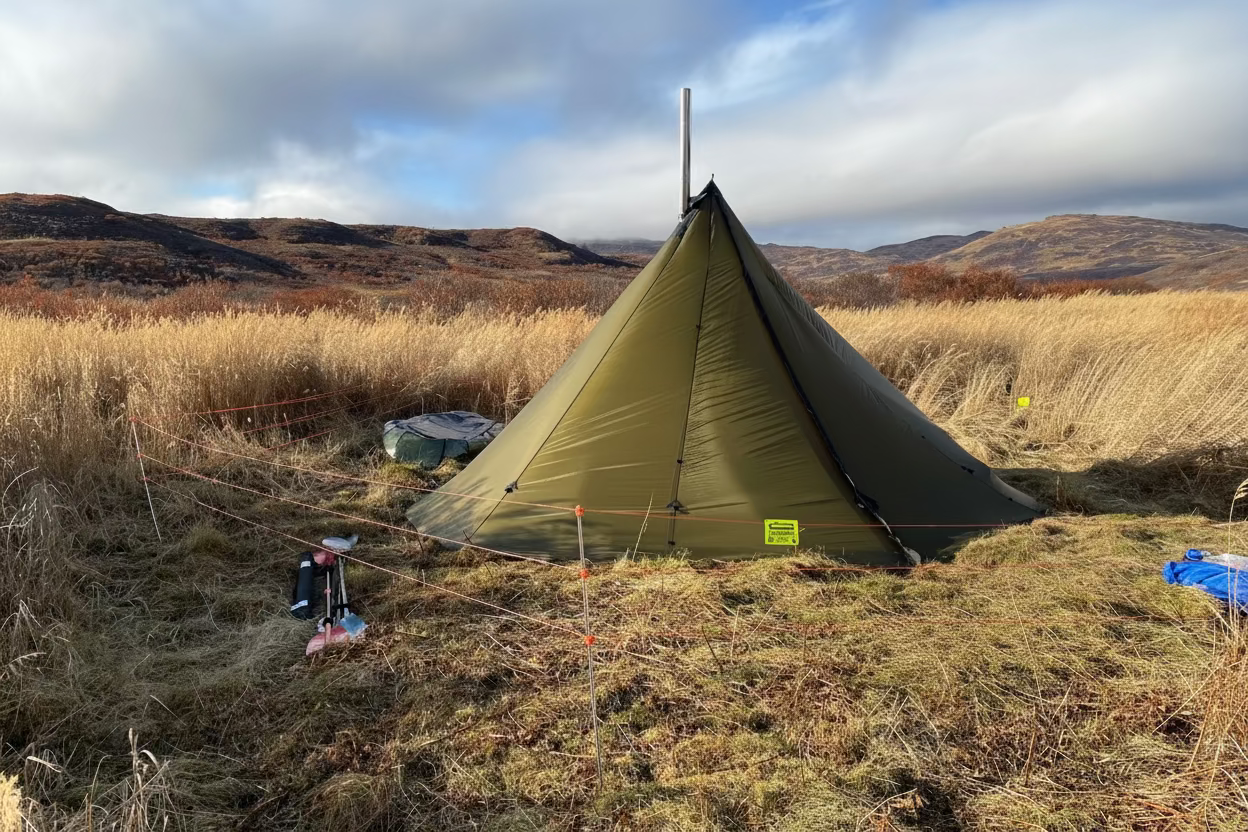
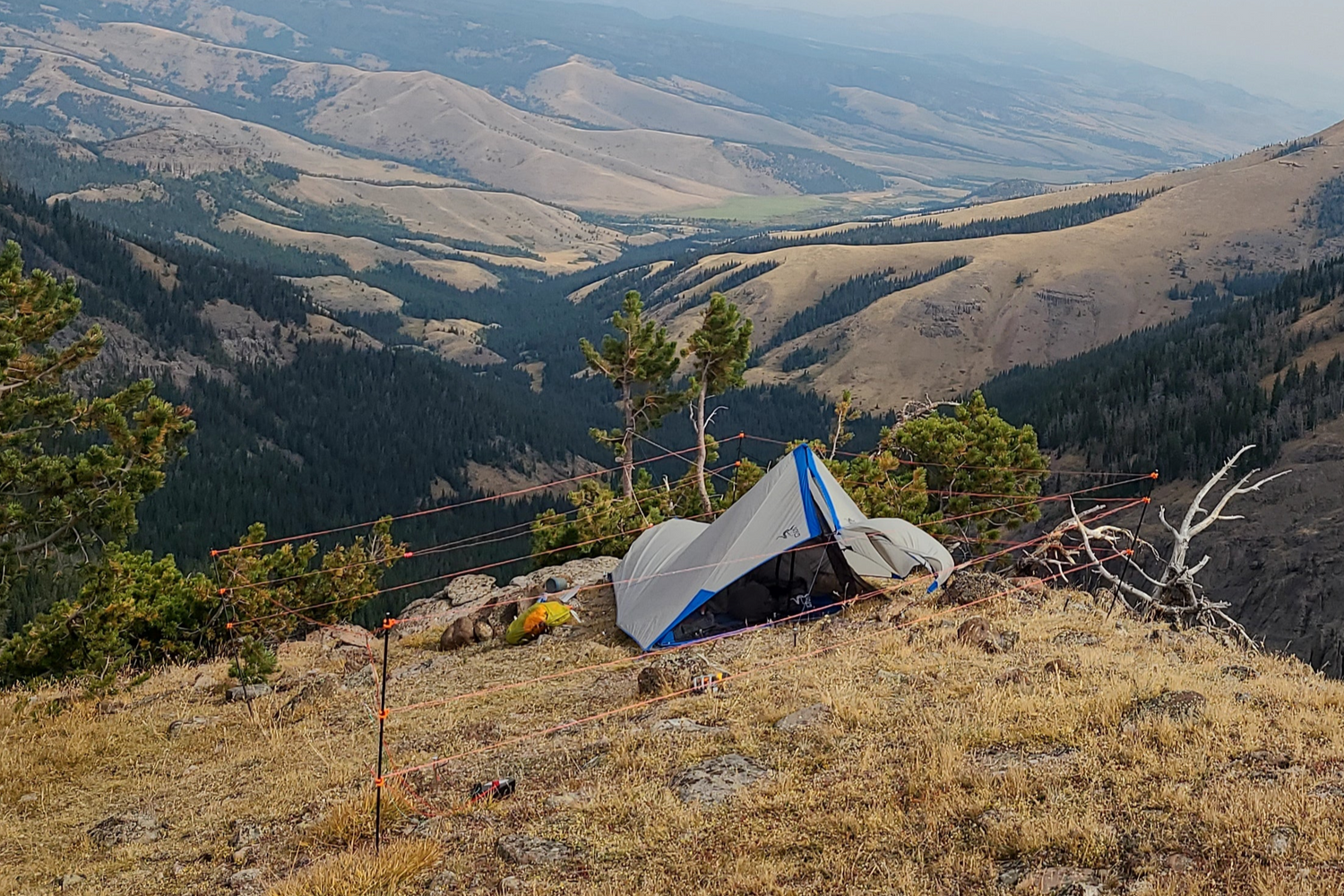
The short answer:
- Every Bearwatch Systems fence is a complete kit with the same energizer and hardware. The only real decision is footprint: 20 x 20 ft for a backpacker's tent up to 40 x 40 ft for a full basecamp.
- The sizing rule: leave about 6 feet of clearance between the fence and your tent, guylines, and gear.
- Counting grams? The same 20 x 20 ft coverage comes in carbon fibre at 2.08 lbs.
- Every fence can be set up smaller than its full size when your campsite is tight.
Five systems, one question: how much ground do you want inside the wire? Same deterrent, same kit, different footprint. Here is how to read the sizes, and the one rule that makes the choice for you.
Which fence size fits your camp
| System | Best for | Footprint | Poles | Weight |
|---|---|---|---|---|
| Standard Ultralight | Ounce-counting backpackers | 20 x 20 ft (400 ft²) | 4, carbon fibre | 2.08 lbs (0.95 kg) |
| Standard | Most backpackers and solo campers | 20 x 20 ft (400 ft²) | 4, aluminum | 2.4 lbs (1.1 kg) |
| Standard Plus | Larger tents | 25 x 25 ft (625 ft²) | 4, aluminum | 2.8 lbs (1.3 kg) |
| 6-Pole | Small groups | Hexagon, or 20 x 40 ft (up to 1,039 ft²) | 6, aluminum | 3.2 lbs (1.45 kg) |
| 8-Pole | Large camps, overlanding, wall tents | Octagon, or 40 x 40 ft (up to 1,931 ft²) | 8, aluminum | 3.6 lbs (1.65 kg) |
Every footprint in that table is a maximum, not a fixed shape: the poles and wire will happily set up smaller when your site is tight (more on that below). All five systems stand on the same 41 in (105 cm) poles, which fold into three sections to pack down small, and every weight in the table includes the energizer. So the question is really "what is the biggest camp I pitch?", and the answer usually points at one row.
The sizing rule: six feet of clearance
Pick your fence the way you pitch your camp: tent first, then room to move. We recommend about 6 feet (2 meters) of clearance between the fence line and everything inside it, your tent, its guylines, and your gear, and never less than 3 feet (1 meter). Overlanding or camping beside a vehicle? Measure with the doors open, because that is how mornings actually look.
To size your camp, pace it out once: the space your tent and gear actually occupy, plus six feet on every side. That is exactly how the lineup maps out on our own listings: the 20 x 20 systems are sized around a backpacker's tent, the 25 x 25 around larger tents, and the 6-Pole and 8-Pole around group and basecamp setups where several tents, or a vehicle, live inside the wire.
See all five systems side by side.
Going light: two ways to carry 20 x 20
The Standard is the workhorse of the lineup: four aluminum poles that fold into three sections, a 20 x 20 ft footprint, and 2.4 lbs in your pack.
The Standard Ultralight is the same fence, upgraded: identical 20 x 20 ft coverage with carbon fibre poles in place of aluminum, bringing it down to 2.08 lbs, the lightest full perimeter we make. If you count your base weight in grams, this is your fence; if you just like carrying less, that works too.
Room for bigger tents: the Standard Plus
A large tent with long guylines eats a 20 x 20 footprint fast. The Standard Plus stretches the same four-pole setup to 25 x 25 ft, which is over 50% more enclosed area (625 ft² vs 400 ft²), so the recommended clearance survives even around a roomy family tent. At 2.8 lbs, it is still very much packable weight.
Small groups, two shapes: the 6-Pole
Six poles buy flexibility as well as area. Set the 6-Pole as a hexagon around a cluster of tents, or stretch it into a 20 x 40 ft rectangle for a row of tents or a tent-beside-vehicle camp, up to 1,039 ft² enclosed. If your trips are "two or three tents, one camp," this is the row in the table for you.
Basecamp scale: the 8-Pole
Set the 8-Pole as a full 40 x 40 ft square, four times the area of the 20 x 20 systems, or spread the same poles into a wide octagon and enclose up to 1,931 ft². This is the one for large camps, wall tents, and overlanding setups where the vehicle, the awning, and the doors-open rule all want to live inside the perimeter, and at 3.6 lbs it still packs like camping gear, not like fencing.
Make it smaller anytime; go bigger with a custom build
Buying the bigger footprint does not commit you to it. Built-in fence tension adjusters work like guyline tensioners: pull the perimeter in and the same system sets up neatly in a tighter site.
For a bigger drop in size and weight, do what many of our customers do and run one system as two fences. Add a shorter spool of polywire, sized by the fence footprint you want to run, and leave the extra parts at home. An 8-Pole, for example, covers basecamp at its full size; for a spike camp or a fast side trip, pack just four of its poles and the 20 x 20 ft spool, and the same system sets up as a tidy 20 x 20 ft camp. If your seasons swing between basecamp and fast-and-light, that is one purchase covering every trip on the calendar.
And if your site needs more than 40 x 40 ft, or a 5-wire build instead of the standard 3 wires, we make custom systems. Tell us what you are setting up and we will spec one to fit.
The right size, and the best sleep in bear country
What you are really buying is a full night's sleep in bear country, and the size you choose is part of how you get it. With about six feet of clearance on every side, the fence, not your tent, is the first thing a curious nose meets, and its job is to deter all night while you sleep.
You do not have to take our word for the concept. Tom S. Smith, Ph.D., Research Ecologist - Bears at the USGS Alaska Science Center, has spent a decade testing electric fences in bear country. As he puts it:
"Over the past decade, I have tested many fences in many settings - all of them thick with bears - and have never had an electric fence fail to keep bears out."
A Bearwatch Systems fence is designed to deter black and brown bears, and it earns its keep as one layer of a bear-smart camp, working alongside the precautions your local wildlife agency recommends.
The bottom line
Match the footprint to the camp you actually pitch: 20 x 20 for one tent (aluminum or carbon fibre, your call), 25 x 25 for a big tent, the 6-Pole for small groups, the 8-Pole for basecamp scale. Between two sizes? Take the larger, clearance is exactly what it buys. Every kit arrives complete: energizer, poles, polywire, grounding hardware, warning signs, carrying bag, and a waterproof manual, along with the fence voltage tester that confirms your fence is live, included standard in every kit (a $25 value).
Ready to put a perimeter around your next trip? Shop fence systems. Still between two rows of the table? Tell us how you camp and we will spec it with you.